AI Automation by Industry: How 8 Sectors Are Already Winning in 2026
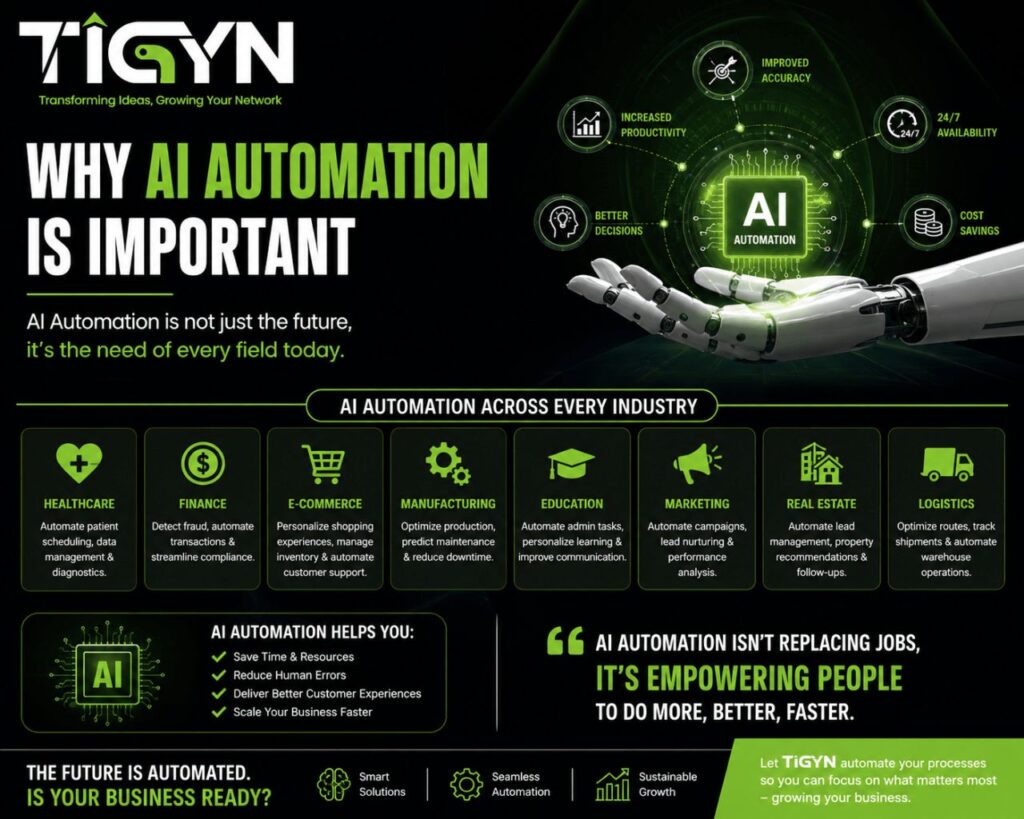
AI automation is no longer a future plan sitting on a slide deck. It is running inside hospitals, banks, warehouses, and marketing teams right now, handling the repetitive work so people can focus on what actually needs a human.
The businesses seeing the biggest gains are not the ones automating everything at once. They are the ones that know exactly where AI automation fits in their industry, and they start there.
This guide breaks down how eight industries are using AI automation today, with real use cases for each. If you are still asking what AI automation actually is and how it works, read our complete guide to AI automation. first. This one picks up where that leaves off.
Why Industry Context Matters
Generic advice about “automating your business” only goes so far. A hospital and an eCommerce store do not have the same repetitive tasks, the same compliance requirements, or the same customers waiting on the other end.
That is why the businesses getting real results treat AI automation as an operational decision specific to their industry, not a one-size-fits-all software rollout. The starting point looks different everywhere. So does the payoff.
With that in mind, here is where AI automation is already delivering measurable value, industry by industry.
- Healthcare
Healthcare has seen one of the fastest jumps in AI adoption of any industry, moving from roughly a third of organisations in 2024 to well over half in 2026 as clinical tools and regulatory guidance have matured
In practice, that shows up in three places:
Appointment scheduling that reduces no-shows through automated reminders and rebooking
Patient support, where AI-powered chatbots now handle a meaningful share of initial patient inquiries at major healthcare networks, freeing staff for direct care
Record management, including automated intake forms and data entry that cuts administrative time per patient
The common thread is administrative relief, not clinical decision-making. Most healthcare organisations are automating the paperwork around care, not the care itself.
- Finance
Banking, financial services, and insurance are among the heaviest AI spenders of any sector, with high-value use cases in risk modelling, fraud detection, and compliance reporting.
Common finance use cases include:
Invoice processing that reads and enters data automatically instead of manual keying
Fraud detection that flags unusual transaction patterns in real time
Reporting and compliance automation that keeps up with regulatory requirements without adding headcount
Finance is a good example of an industry where the cost of an error is high, which is exactly why AI automation is being adopted carefully, alongside human review, rather than left to run unsupervised.
- E-Commerce
Customer service is the most automated function in e-commerce today, and it is on track to cover roughly half of all customer interactions within the next couple of years.
For online stores, that typically means:
Customer support through chatbots that handle order status, returns, and common questions
Order processing and inventory updates that stay in sync automatically across channels
Personalised shopping experiences, from product recommendations to cart recovery messages
Retailers running these flows report a direct impact on conversion rate and average order value, because the automation is working during the moments that actually influence a purchase decision.
- Manufacturing
On the factory floor, AI automation is less about customer-facing tasks and more about keeping equipment running and quality consistent:
Production monitoring that tracks output and flags deviations as they happen
Predictive maintenance that catches equipment issues before they cause downtime
Quality control using AI-based visual inspection instead of manual spot checks
Manufacturing is one of the clearest cases where AI automation pays for itself through avoided downtime alone, before any productivity gains are even counted.
- Education
Education institutions are automating the operational side of running a school, not the teaching itself:
Student onboarding, including enrolment forms, document collection, and welcome communications
Administrative automation for scheduling, attendance, and records
AI-powered learning assistance that supports students outside classroom hours
This frees up staff and instructors to spend more time on the parts of education that genuinely need a person: teaching, mentoring, and student support.
- Marketing
Marketing teams were early adopters of AI automation because the tasks are naturally repetitive and data-heavy:
Lead qualification that scores and routes inbound leads automatically
Email campaigns that trigger based on user behaviour rather than a fixed schedule
Social media automation for scheduling and initial performance reporting
The teams getting the most out of this are using AI to handle the volume work, then spending their saved time on strategy and creative, the parts automation cannot do well.
- Real Estate
Real estate businesses run on follow-up, and that is exactly where AI automation is having the biggest impact:
Lead nurturing that keeps prospects warm with timely, relevant follow-ups
Appointment scheduling for viewings and consultations without back-and-forth emails
Document automation and CRM integration that keeps contracts, disclosures, and client records organised automatically
Agents and agencies using this well are not replacing the relationship-building part of the job. They are removing the admin that used to eat into the time available for it.
- Logistics
Logistics and supply chain businesses deal with constant, high-volume, time-sensitive data, which makes them a natural fit for automation:
Shipment tracking that updates customers automatically at each stage
Route optimisation that adjusts to traffic, weather, and delivery windows in real time
Inventory management that flags stock issues before they become fulfilment problems
For logistics operations, the value shows up directly in on-time delivery rates and lower operational overhead, two of the metrics that matter most in the industry.
The Pattern Across Every Industry
Looking at all eight sectors together, the same five outcomes show up again and again:
| Outcome | What it looks like in practice
| Time savings | Repetitive tasks completed in seconds instead of hours
| Fewer errors | Consistent data entry and processing, without manual slip-ups
| Faster response | 24/7 support and processing instead of business-hours-only
| Better decisions | Data-driven insights surfaced automatically, not buried in spreadsheets
| Scalability | Handling more volume without a matching increase in headcount
None of this is about removing people from the process. In every industry above, AI automation is taking on the repetitive, rules-based work so teams can spend their time on judgment calls, relationships, and strategy, the things that still need a human.
How to Find the Right Starting Point in Your Industry
You do not need to automate everything at once, and you should not try to. A focused approach works better:
- Look at your own list above. Identify which of the use cases for your industry matches a task your team handles manually today.
- Pick the one with the clearest cost. The best starting workflow is usually the one costing the most time or causing the most errors right now.
- Run a small pilot first. A single automated workflow will tell you more about what works in your business than a large rollout will.
- Measure before you expand. Track time saved, error rates, or response times, then use that data to decide what to automate next.
This is the same structured approach we walk through in our [AI automation guide](https://tigyn.com/what-is-ai-automation-benefits-for-business/), which covers how AI automation works, the risks to plan for, and a full step-by-step rollout process.
FAQ
Which industry benefits most from AI automation?
There is no single answer. Healthcare and finance currently show the fastest adoption growth, but eCommerce and logistics see some of the clearest, fastest-measurable returns because the results show up directly in conversion rates and delivery times.
Do I need a different AI automation approach for my industry, or is it all the same tools?
The underlying tools often overlap, but the best starting workflow, the data you are working with, and the compliance considerations are industry-specific. That is why the use case, not the tool, should drive the decision.
Is AI automation only useful for large companies in these industries?
No. Small and mid-sized businesses in every industry listed here are automating specific workflows, such as appointment scheduling or invoice processing, without needing an enterprise budget or an in-house AI team.
How do I know if my industry’s use cases apply to my business specifically?
Start with the use cases listed for your industry above and check which ones match a task you already do manually. If one clearly costs you time or causes errors today, that is your starting point.
Ready to Automate for Your Industry?
Every industry has its own version of “the repetitive task that is eating your team’s time.” TIGYN helps businesses identify that task, build the right automation around it, and integrate it into the systems you already use.
Get in touch with TIGYN to talk through what AI automation could look like in your industry, or explore our full range of services.